Grassroots Innovations Assembly for Agroecology (GIAA)

Why Grassroots Innovations?

Even though smallholder and family farmers produce about 80% of our food, the technology we commonly use and promote favors larger farms. Small-scale food producers are addressing this issue by working together to create their own innovative solutions. These grassroots technologies help small farmers adjust, make a profit, process their own products, save resources, and exchange knowledge. With small farmers facing increasing challenges from environmental issues and big corporate farming, it’s crucial to build stronger networks to empower them with their own technology solutions.

In response to the challenges of Agriculture 4.0 and other pressures faced by smallholders, we are launching the Assembly for Grassroots Innovations in Agroecology. This global network collaborates to empower smallholders with control over their technology. GIAA gathers organizations, local networks, researchers, and individuals who share our vision, including those representing farmers, fisherfolks, pastoralists, seed savers, and local food processors. This also includes groups involved in spreading technological innovation, which encompasses physical tools, equipment, and digital solutions.

Our goal is to foster solidarity and trust among organizations working toward agroecology and food sovereignty, mutually supporting and energizing each other’s efforts. We recognize the power of collective intelligence that emerges through collaboration across regions and organizations. Just as local communities can solve their specific challenges through co-creation, international and regional collaboration can drive innovation and partnerships to address broader systemic issues.

Second in-person gathering of GIAA, in Ahmedabad (India) - January 2025

The Grassroots innovations assembly for Agroecology (GIA) gathered in Ahmedabad (India), end of January 2025 for a 3 days internal meeting, and 3 days of participation to the Fifth International Conference On Creativity And Innovation At/For/From/With Grassroots. The giant efforts of our host Honey Bee Network and @GIAN made possible to welcome 15 organisations, active at the grassroots’ level for developing local solutions to farmers’ real needs ; Schola Campesina Aps, (hosting GIA secretariat), is immensely grateful to their team: @Prof. Anil Gupta, @Anamika, Aneeta Salaria, @Deepika, @Kishore, @Sapna and others. Apart from the richness of the exchanges, these past days have been full of joy, kindness, care and humanity.

Some findings from our exchanges :

1. Horizontal learning processes, free of hierarchy are the learning environment where local solutions can trigger,
o  Our learning culture, methods and mechanisms that are peer-to-peer, poeple-centred, and grounded in ancestral knowledge, are the necessary ground for communities to develop their own solutions ; and gain autonomy.

2. The increasing concentration of data, technologies and power in the hand of few actors is working against grassroots solutions.
o  The Innovation concept is not neutral. Awareness is essential. Alternative tools too.
o  What kind of technologies are making us gaining autonomy ? Our collective intelligence (GIA and allies) should continue drawing a (context neutral) tech assessment framework for agroecology.

3. Our social processes for identifying needs, co-creating, documenting and sharing solutions are real knowledge to be further exchanged within this Assembly

4. The needed technical, legal and financial tools, mechanisms, infrastructure to safely share local innovations and guarantee the Rights of knowledge holders
o  Social agreements, Common licence, IP regulations, Prior consent for sharing, Commons Governance Organization (CGO), Ag Data Oath of Care and Ag Data Bill of rights, Glossary, appropriate languages used, databases and repositories ; Guidelines for documentation, Funds for grassroots R&D, etc. (OpenTeam, Farm Hack and Prolinnova longstanding experiences)
o  How to safely enable a sharing of our innovations, farmer to farmer, accross continents ? Through an Agricultural Knowledge Common ?

5. Our economical strategies for ensuring a grassroot-driven research and development processes of innovations.
o  Organisation internal capacities, Public funding and infrastructure, Strategic alliances, …

6. We work for society transformation, our alliance with social movement of Nyéléni and the networks of LVC Agroecology schools is essential.

7. We explored ideas for concrete common activities, and the needed adequate governance model of our assembly.

2025 will be a dynamic year of exchanges on the above topics. We are looking forward to it !
A proper report will be published on www.gia-agroecology.org

From 28th until 30th of January, 2025, GIA organisations attended the Fifth International Conference On Creativity And Innovation At/For/From/With Grassroots [ICCIG 5], organised in collaboration with Centre of Management in Agriculture, Indian Institute of Management, Ahmedabad, Honey Bee Network institutions and several other international and national institutions.

“Giving voice, visibility, and velocity to creativity and innovative people at the grassroots has been the key goal of inclusive development. Honey Bee Network has emerged over the last thirty-five years as a committed new social movement in support of knowledge-rich, economically poor people. In order to enrich the ecosystem for inclusive and empathetic innovations, the Fifth ICCIG will pool the insights from the ground and global playfields of ideas, institutions, and initiatives by policymakers and also by local/global communities and networks. The conference invited contributions on inclusive innovations from the grassroots from scholars, activists, policymakers, and innovators themselves.

Honey Bee Network started more than three decades ago to raise the voice of collaboration between formal and informal sectors, respect for local/indigenous knowledge for the conservation of biodiversity and associated knowledge systems, sharing of benefits through ethical supply chains, and rewarding local communities and individual innovators and traditional knowledge holders. Today, the concern for inclusive innovation has become much more widespread but the voice of the knowledge-rich, economically poor people and the youth is still not heard adequately” . https://www.iccig.org/

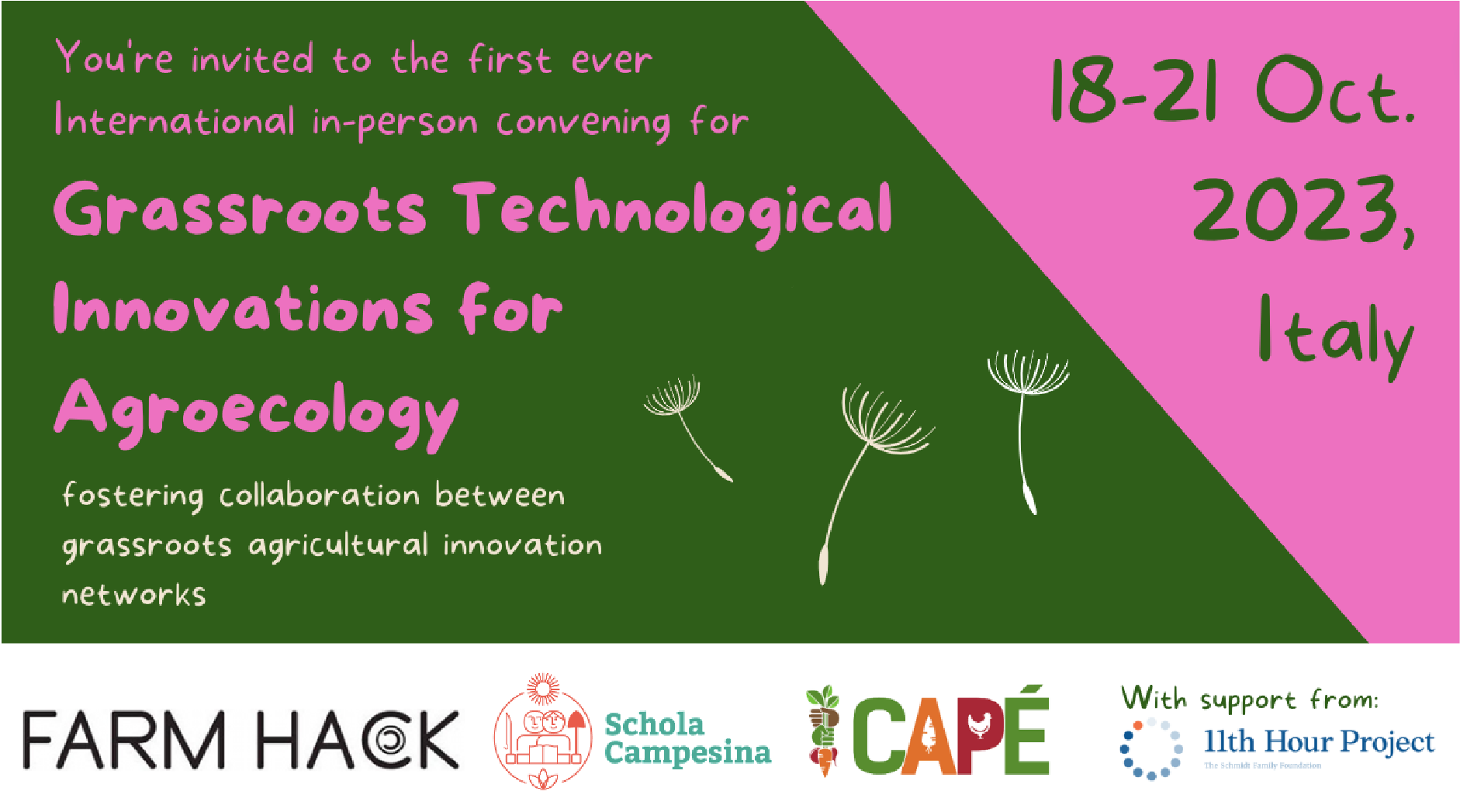
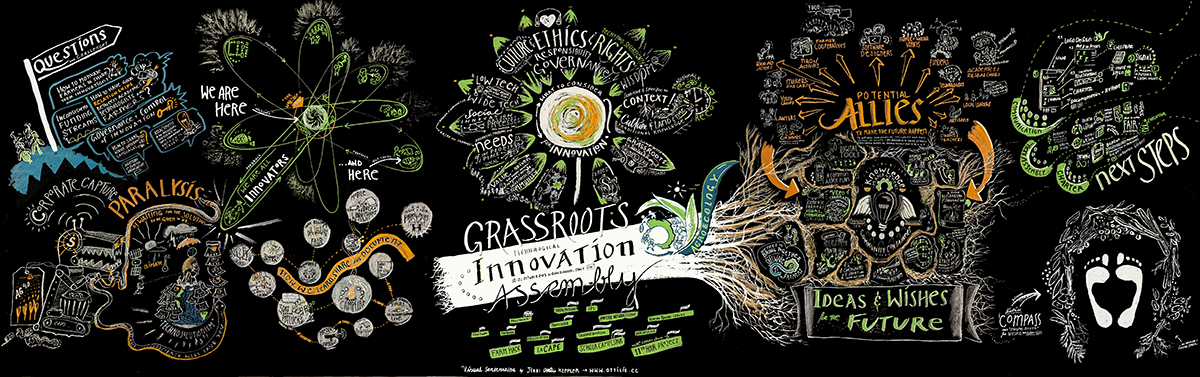
Grassroots Innovations Assembly for Agroecology Assembly in-person meeting. Three and a half days of exploration on technology sovereignty for Agroecology in October 2023, in Gallese, Italy

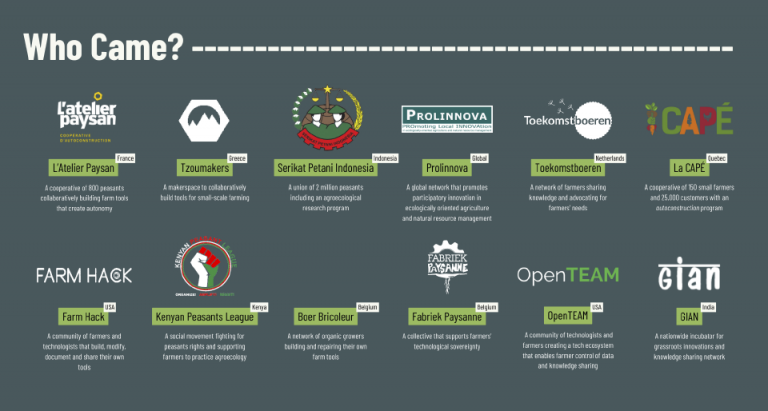
The Grassroots Innovations for Agroecology Assembly took place in the Biodistrict della Via Amerina e delle Forre, Italy, from October 18 to 21, 2023. It was a gathering where organizations of various backgrounds from around the world came together to be part of a broader movement focused on technology sovereignty and to share their challenges and paths forward.

One key takeaway from the assembly was the recognition of the need for collaboration among diverse stakeholders, including smallholder organizations, researchers, IT developers, and experts. Together, they aimed to advance smallholder-driven technological and digital innovations.

Who is Providing Solutions to Your Farming Challenges?

  • If you have the support of SPI, KPL, La CAPE, or l’Atelier Paysan, consider yourself fortunate. These organizations will assist in developing collective solutions, work on the recovery of traditional knowledge, host workshops for creating the technology you need, and facilitate the exchange of skills and techniques.

  • Alternatively, you may find solutions within your communities. Craftsmen can help you design or adapt your tools, young individuals can develop the necessary apps for your community, and elders can share valuable knowledge.

  • In contrast, companies may sell you technologies that, in many cases, lead to increased dependencies, reduced knowledge, and diminished adaptability. This approach is fundamentally incompatible with agroecology, which places knowledge and autonomy at its core.

The Grassroots Innovations for Agroecology Assembly concluded with a shared commitment to working together in the future. The goal is to increase the visibility of technology sovereignty, expand our collective efforts and activities, and foster strong collaborations with various stakeholders in the societal transformation towards agroecology, particularly researchers and experts.

How to get involved

 If your organization wishes to learn more about the Assembly, please contact us at info@scholacampesina.org

Read and watch more